




Akyver - Multiwall Polycarbonate
What are the differences between PET and PETG

A few months ago we already made a
This time we are going to focus on explaining the main differences between PETG and PET, and thus, helping our customers as much as possible in choosing the most suitable material according to their needs.
While PET (polyethylene terephthalate), is a polymer which is obtained by combining two monomers from a polycondensation reaction resulting in a polymer thermoplastic linear with a high degree of crystallinity. PETG has the same composition as PET, to which an additive such as glycol has been added. With this variation, this polymer copolyester achieves an improved behavior compared to its predecessor in different aspects such as its transparency, resistance or flexibility.
Excellent optical quality
El polyethylene terephthalate It is defined by being a material semicrystalline, when it undergoes heating processes, depending on how they occur, it may see its appearance somewhat altered, with the resulting plaque showing a certain degree of whitening. This alteration is due to the fact that it has undergone a process of crystallization, that is, the polymer chains that compose it align and affect its translucency. On the other hand, the PETG, is a amorphous copolyester whom Does not crystallize with the increase in temperature or with other handling processes. The resulting plates, even after undergoing thermomoulding, folding or machining processes, continue to have excellent optical properties, most notably their transparency.
High impact resistance
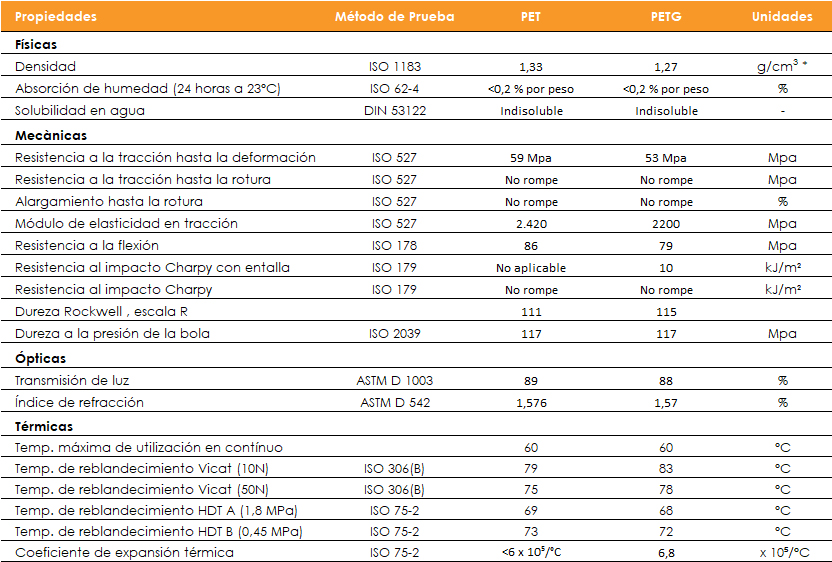
Al PET although with a usual good impact behavior, the effect of the possible crystallization In addition to altering your physical appearance, you can affect your stamina. Thus, if the heating rate is not reduced and its crystallization is prevented, its load capacity may be compromised, modifying at some points on the plate, thus altering the resistance of the assembly. This problem in the PETG is not produced, being defined as a thermoplastic characterized by a high impact stability, although both its Izod resistance and its working temperature resistance range are lower than that of compact polycarbonate. It should be remembered that both materials should not be exposed to continuous temperatures of more than 60ºC, since in both cases they lose their dimensional stability.
Thermomoulding at lower temperature
The possibility of thermomolding without pre-drying in both materials they economize the aforementioned process. You always have to work in a temperature range of 120º C to 150º C, in the case of PET, and somewhat higher with PETG, from 120º C to 160º C.
It must be said that in the case of PET, to prevent its crystallization from occurring and therefore its behavioral alteration, it is necessary Reduce the heating rate, not forgetting that the temperature of the The mold must not exceed 60º C. In the case of PETG, this effect does not occur. Providing the ability to use different thermoforming techniques, to give it the desired shape once hot, either with mechanical force, with compressed air or by vacuum. The molds can be made of plaster, water-cooled steel, cast aluminum or other materials, such as wood, plaster or epoxy.
High resistance to a wide variety of chemicals
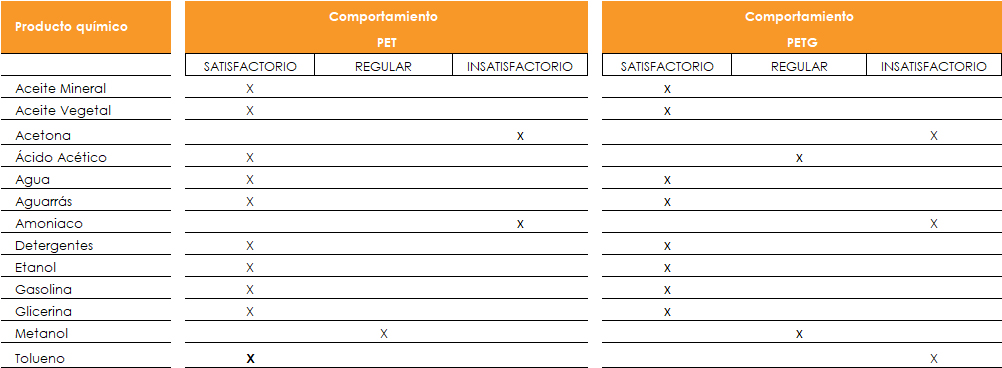
The two materials have a lot good behavior faced with a large number of chemistsThus, polyethylene terephthalate is characterized by its resistance to a large number of acids, alcohols and salts, as well as to plasticizers. It performs well when exposed to hydrocarbons such as xylene, mineral oils and petroleum, it is limited in contact with aliphatic hydrocarbons and exposure to acetones and benzenes must be avoided. PETG responds satisfactorily to hydrocarbons such as mineral and vegetable oils, turpentine, sodium hypochlorite and alcohols: ethanol and glycerin and regularly to methanol, it is attacked by solvents such as acetones, chloroform and ethyl ether, as well as by ammonia or toluene.
FDA-certified materials
In both In cases, these materials meet the requirements of the FDA (Food and Drug Administration, USA) so they are certificates To be in contact with food, in addition to being able to be used in medical applications. PET is odorless and tasteless and can be sterilized with gamma rays or with ethylene oxide, PETG can also be sterilized by radiation, but not by autoclaving.
Standard characteristics of resin
Chemical resistance materials






















.jpg)