




Cast / Extruded Acrylic
Key concepts for the viability of recycling plastic products

What's the difference between an efficiently recyclable plastic product and one that isn't? Depending on the composition (if it is monocomponent or not), the number of times it can be recovered without altering its properties, or the use and size for which it is designed, we can determine the degree of recyclability of a plastic product. Today, there are still many products made with polymers that either cannot be recycled, or it is extremely expensive and difficult to do so. So the alternative is to take them to the landfill or to have them incinerated as an energy source.
We will consider a plastic product to be highly efficient, if it participates in the following value chain: product - recycling - transformation - new product. To achieve this objective, both the consumer, the waste manager, the processor that treats them and converts them into new raw materials, and the manufacturer must collaborate.
For this circuit to be carried out, the role of the product designer is fundamental, because with his choices, he will determine how recyclable he is. Depending on whether it is made of one polymer or another, whether it mixes different materials or the end use.
Plastic materials are usually identified with their SIC (resin identification code), but this does not determine the degree of recyclability of the final product. To do this, the designer must take into account a series of criteria:
- Choice of polymer: thermoplastic, thermosetting or elastomer
- Material recycling limit
- Type of application and composition
Choice of polymer: thermoplastic, thermosetting or elastomer
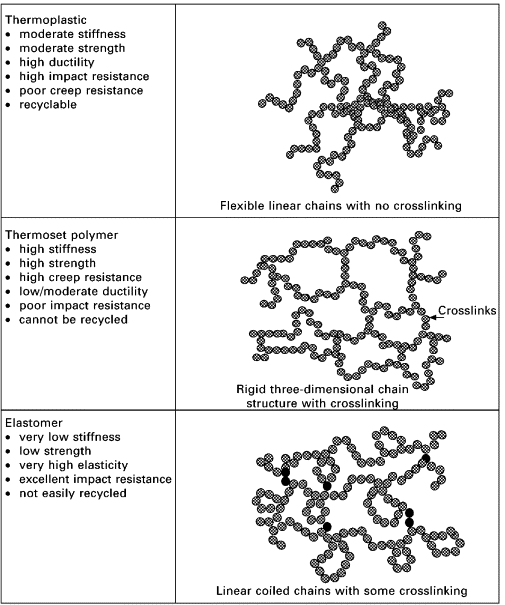
According to their physical properties and, in particular, their behavior against heat, plastics can be classified as:
- Thermoplastics.
All those that melt at high temperatures are then cooled, hardened and retain their new shape. This cycle can be performed repeatedly, making them highly recyclable materials.
Most of the plastic materials used in everyday life are thermoplastics. This group includes methacrylate (PMMA), polyethylene (PE), polypropylene (PP), polyvinyl chloride (PVC), polycarbonate (PC)...
- Thermostable.
They can only be melted and molded once (at the time of manufacture). The curing reaction is irreversible, so that the resulting plastic cannot be recycled, since if the temperature is increased the polymer does not melt, but burns.
Thermostable plastics are polyurethane, some resins such as polyester or epoxy, bakelite, melanin...
- Elastomers.
They are characterized by their elasticity, which allows them to recover their initial shape after being deformed. Elastomers can rarely dissolve or melt, given their tendency to return to their original state. Its recycling is complex.
Rubber (natural and synthetic), neoprene and silicones are elastomers.
Material recycling limit
Depending on the type of thermoplastic, the number of times it can be recycled without altering its physical properties changes considerably. This fact should be taken into account in the case of plastic products made from recycled materials, since they must offer a behavior equivalent to those made with virgin raw material.
Type of application and composition
Not all applications, sizes and products are recyclable. Depending on the use, if they contain more than one component, are in contact with organic matter or are of small size and value, the management process is extremely complex. Even requiring specific machines to separate the different compounds, which makes the management and screening process more expensive and difficult.
For all these reasons, it is so important during the design phase to think about how the product will be able to manage once its useful life has ended and what materials are used.
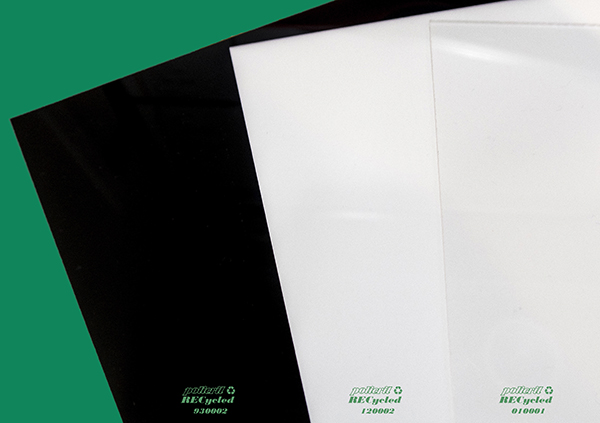
For example, Policril Recycled, are cast methacrylate plates that are made with raw material from 100% recycling. Thanks to the properties of acrylic, this material can be repeatedly depolymerized/distilled/polymerized without altering its properties.
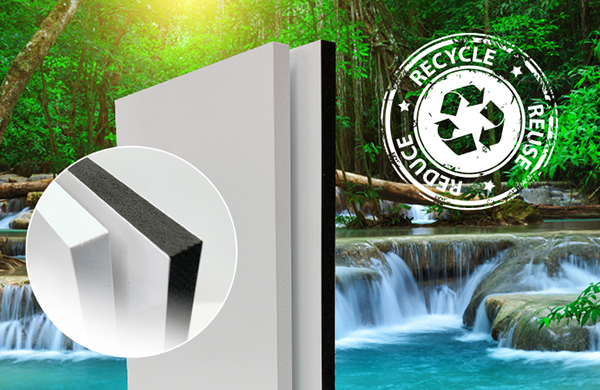
Other solutions involve combining recycled and virgin material at the same time, such as our FO06, where the core of the product comes from recycling and the outer layers are solved with virgin resin, resulting in a material produced with more than 50% recycled PVC and 100% recyclable.





.jpg)