




Akyver - Multiwall Polycarbonate
UL 94: Flammability testing of plastic materials for device parts and artifacts

On previous occasions, we have used this space as a means of disseminating concepts related to flammability in plastic materials or the regulatory framework that applies to them, provided that the final use of the material was construction.
In this post, we are going to focus on how thermoplastics are classified and what type of tests are performed, provided that the end use is that of parts of devices or artifacts.
Flammability and classification regulations
To begin with, it is important to define the concept of flammability of a plastic material, which is determined by the tendency of a silicone or a thermoplastic to extinguish or spread the flame when they burn.
The procedures and the qualification system that are taken as a reference for these uses are included in the UL94 standard for flammability testing of plastic materials for parts of devices and artifacts. In addition, it is harmonized with IEC 60707, 60695-11-10 and 60695-11-20 standards and ISO 9772 and 9773.
UL94 Flame Rating
12 flame classifications are specified in the standard for materials based on test results. These classifications, presented in descending order and in 3 large groups, are used to distinguish the combustion characteristics of a material after exposing the test specimen to a specific flame in a controlled laboratory environment.
- Six of the classifications refer to plastic materials commonly used in enclosures, structural/insulating parts of consumer electronic products (5VA, 5VB, V-0, V-1, V-2 and HB).
- Three of the remaining six refer to low-density foams, commonly used in the construction of grilles and acoustic insulating material (HF-1, HF-2, HBF).
- The last three correspond to thin sheets that can generally remain in a horizontal position (VTM-0, VTM-1, VTM-2). These are usually used in flexible printed circuit boards.
Horizontal versus vertical position
The thermoplastic samples are placed in a horizontal or vertical position, depending on the specifications of the test method, they are exposed to a specific flame ignition source for a specific period of time. Depending on the type of test, the flame is applied only once, as in the case of horizontal combustion (horizontal burning, HB), while in others it can be applied up to 5 times.
The degree of flammability, HB, indicates that the polymer was tested in a horizontal position and that the burning time is shorter than the specified maximum.
The degree of vertical flammability, V2, V1 and V0, indicates that the polymer was tested in a vertical position and that it self-extinguished within a specific period of time after removing the ignition source. It is also indicated if flaming particles were released from the test specimen that ignited the cotton indicator under the sample.
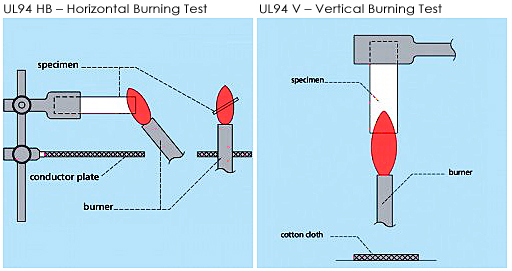
Finally, indicate that the standard determines the method in which the test flame is applied in 5 applications when carrying out the test that determines a 5VA or 5VB classification, these tests measure the tendency of the polymer to extinguish or to spread the flames after igniting.
Test methods and examples
For information purposes, indicate that in materials used for electronic product enclosures and structural parts (5VA, 5VB, V-0, V-1, V-2 and HB), material of grade 5VA or 5VB is exposed to a flame approximately five times more intense than that used in grade V-0, V-1, V-2 and HB tests.
Next, for illustrative purposes, we will use an example to determine the appropriate polymer if we are required to have specific flammability properties.
In this case, they ask us what thermoplastic we could use for a housing of an indoor signalling lamp, in addition to ensuring that the material does not contribute to the spread of fire, it must ensure the stability of the housing to impacts. For this reason, they demand from us a material with a high self-extinguishing range, which the test to which it has been subjected guarantees a series of requirements. First, the test polymer had to be fixed vertically, after being exposed to a Bunsen burner flame for 10 seconds, and the combustion must be extinguished in 10 seconds without dripping. In this case, we would recommend a material classified V-0 with high impact resistance, such as our PC 07 F-2000, compact flame retardant polycarbonate, with a thickness between 3 and 6 mm, which will be determined depending on the dimensions of the final piece.


.jpg)