



Akyver - Multiwall Polycarbonate
HPL and Thermoplastic Coating Materials - Differences

Due to their wide scope of application, generally in the world of construction and industrial design, coating and finishing materials must meet a series of requirements: availability of a wide variety of colors, a wide range of textures and finishing designs, and high resistance to both chemical and surface wear.
In order to meet these requirements, in the market, we find a wide range of products of different composition and origin, which attempt to respond to these needs. From high-pressure laminates such as HPL, to thermoplastics of different composition such as Kydex (PVC+PMMA) or PC21 Cliniwall (PC+ABS).
HPL stands for “High Pressure Laminate”. They are sheets that consist of several layers of cellulose impregnated with thermostable resins and at the same time subjected to both pressure (>7MPa) and heat (140/150 ºC, varying according to the type of laminate). This process creates a high-density, stable, inert, homogeneous and non-porous material with physical and chemical properties that are totally different from those of its original components. In addition, given its low permeability, HPL acts as a barrier against the possible emission of formaldehyde and other volatile substances (VOCs) from any wooden support on which it is applied.
Kydex combines the properties of polyvinyl chloride and acrylic, resulting in a material that is rigid, deformable, tough and resistant to chemicals. The impact resistance of the PMMA+PVC thermoplastic compound (Kydex) is extremely high, surpassing even that of compact polycarbonate.
It is recyclable and does not contain VOCs, nor does it release them during thermoforming or creating hazardous waste.
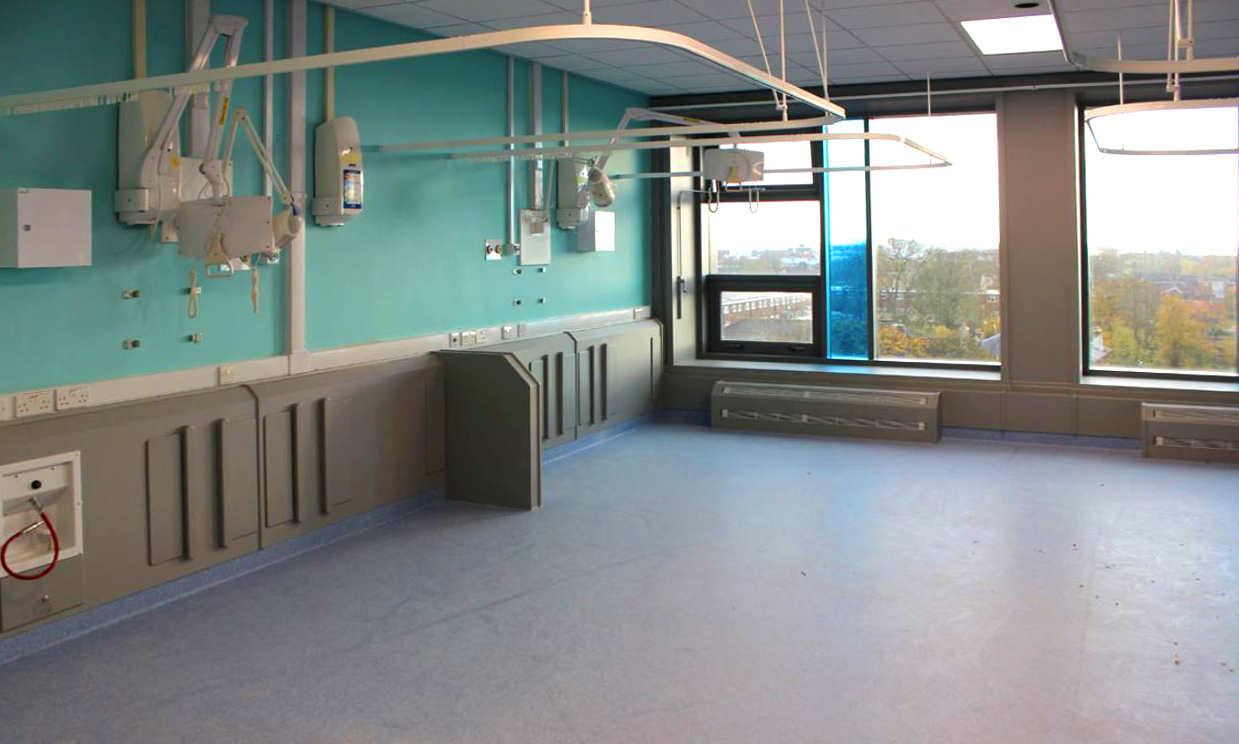
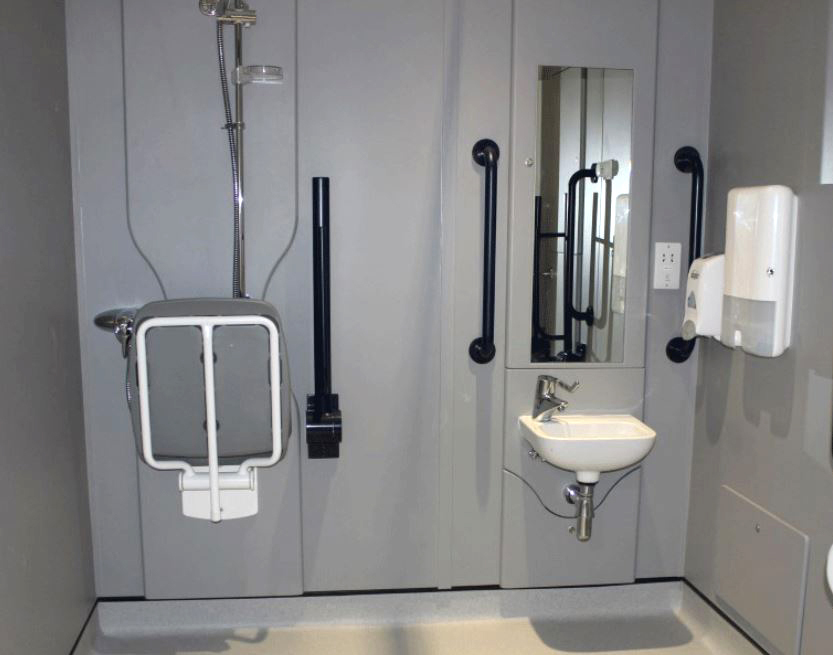
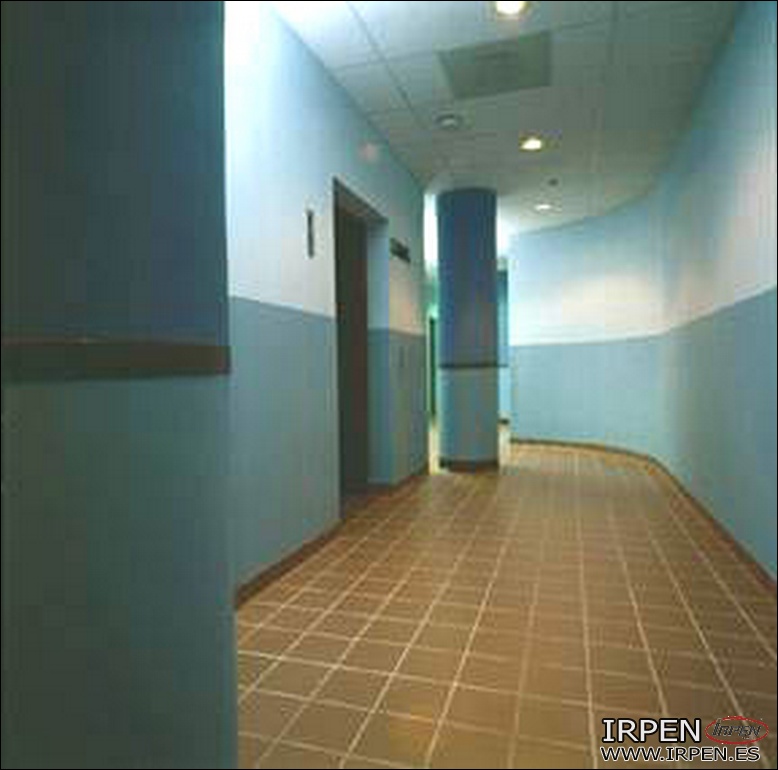
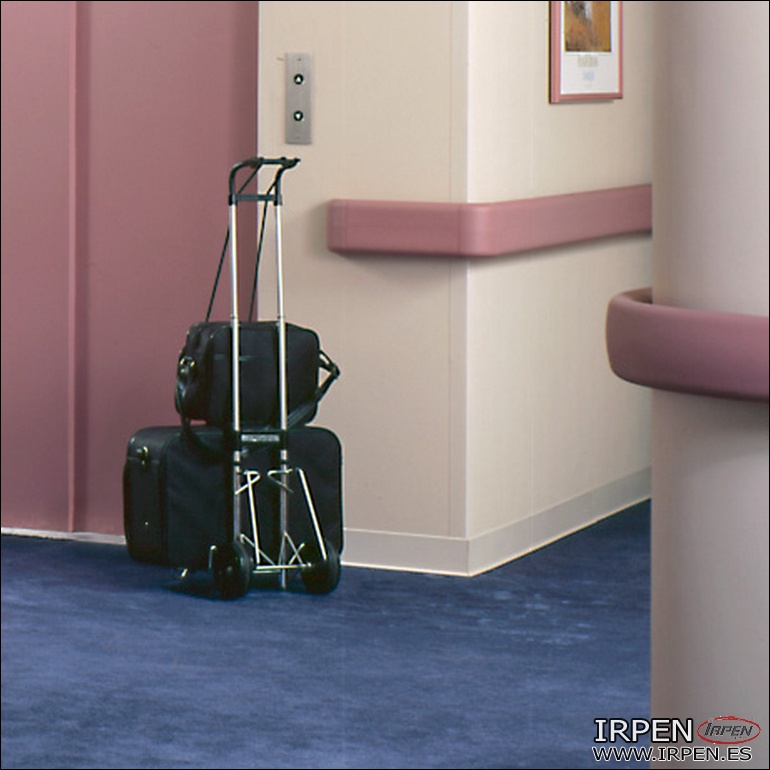
KYDEX apps
PC21 Lexan Cliniwall, is the result of the combination of Polycarbonate and ABS, with high chemical resistance, in addition to being a halogen-free material, thus avoiding, in the event of combustion, the generation of toxic and opaque fumes that are harmful in case of inhalation, as well as being highly corrosive.
All of them have advantages and disadvantages, so depending on the application, the designer will choose which one is the most suitable for the specific job.
Below, we briefly analyze their behavior in reference to:
- Wide range of finish designs
- Surface strength and durability
- Resistance to disinfectant and abrasive materials
- Machining and formability
- Good fire behavior
Wide range of finish designs
In the world of design and architecture, projects are increasingly demanding on materials. In addition to having a wide color palette, available in both the HPL, the Kydex and the Cliniwall, they must allow us to go from a two-dimensional design to a three-dimensional one. That is, going from solving joints through suitable joints to adding depth to the design. In this case, the above-mentioned thermoplastics respond better to these new requirements because, unlike HPL, these materials are flexible, do not exfoliate, break or chip. In addition, both the Kydex and the PC21 can be molded in any of their varieties, so the final design of the product can incorporate details or holes without the need for additional joints, which, if necessary in coatings made with HPL, if not of the postformable type.
Surface strength and durability
Every finishing material must guarantee good resistance to both impacts and abrasion without the appearance of nicks, chips or cracks. Pressure-rolled coatings perform well against impact and wear, but the mechanical resistance of Kydex and Cliniwall is very high, making them materials especially recommended in environments of intensive use, where maintenance is expected to be scarce or non-existent.
Thermoplastic sheets can be adapted to both horizontal and vertical surfaces, those where sharp corners or composite curves are included, offering a recyclable and long-lasting alternative to traditional materials.
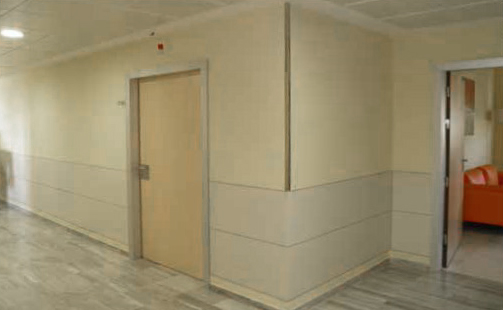


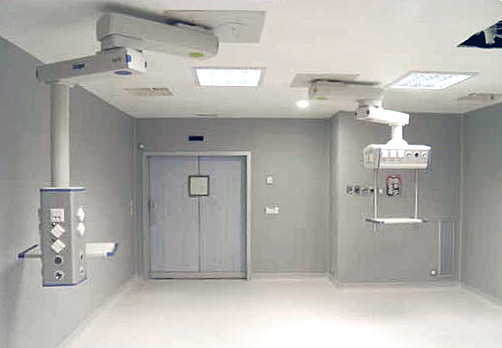
CLINIWAL applications
Resistance to disinfectant and abrasive materials
Kydex is characterized by being a material with low moisture absorption, in fact, this sheet is characterized by being less hygroscopic than ABS or PC, which reduces or in certain cases eliminates the need to pre-dry the material before the thermoforming process, always necessary when we mold the Cliniwall. In the case of HPL, finishing resins provide the surface with impermeable properties, although it is only possible to form certain non-standard qualities.
On the other hand, Kydex is resistant to many chemicals, meeting the highest standards of chemical resistance for thermoplastic materials. It is defined as being more chemically resistant than ABS, HIPS or PC.
Machining and formability
Both HPL, Kydex and PC21 are materials that can be handled and machined with the usual techniques of CNC cutting, drilling and milling. Both thermoplastics allow internal cuts in the plate at 90ºC, while in HPL, these types of cuts can cause breaks or cracks, so they must be rounded, avoiding right angles.
Both copolymers are specially designed to be molded by heat. In the case of Kydex, in parts thermoformed by deep drawing, the thickness of the wall of the sheet is more uniform than in parts made with ABS or PC, the shaping is achieved with the pure stretching of the material, resulting in a piece with a more homogeneous thickness. Thanks to this, with Kydex we can choose a sheet of smaller thickness to be thermoformed depending on the final application.
In the case of pressure laminates, not all marketed variants are suitable for moulding. Quality laminates are required postformable in addition, they require a certain thickness to be thermoformed.
Good fire behavior
Both thermoplastics perform well against fire. The Kydex is suitable for use both in aeronautics and railway transport, as an interior coating material, among other uses. The Lexan Cliniwall meets the requirements of the CTE-DB SI, in this case, this material is suitable for covering ceilings and walls, even in protected corridors and staircases. Since this is a classified placard Bs1d0, according to Euroclasses EN 13501-1, resulting in a combustible material with a very limited contribution to fire, with a low speed and amount of smoke opacity emission and with the absence of inflamed droplets.
On the other hand, in the case of HPL, we need fireproof (non-standard) qualities, to improve its behavior against fire through the use of additives. Thanks to this, it improves its resistance and makes it an optimal material, this variety is called HPL FR.

.jpg)