




Usually in this space we talk about different aspects related to light, if it is visible or not, what spectrum does a certain wavelength correspond to, what color perception we have or what light transmission does a light plate have Polycyril. Therefore, in this post we are going to explain in broad strokes these basic concepts and what specialties of Polycyril can be used according to a specific wavelength. Before going into the matter, we will note that the color of the resulting plate that is perceived by the human eye arises from the combination: of the light transmitted and reflected by the leaf, the nature of the light source and the angle of incidence of the latter on it. Therefore, it is necessary to remember that colors must be evaluated under the parameters of end use, in order to help in the best choice of color, light transmission and reflection can be used as a guide, but real evaluation with the final conditions is always recommended to achieve the best result.LuzLight or electromagnetic radiation can be divided into different bands or categories depending on the specific wavelength range. Therefore, there are different types of electromagnetic radiation such as ultraviolet light, visible light, x-rays, radio waves or infrared light.
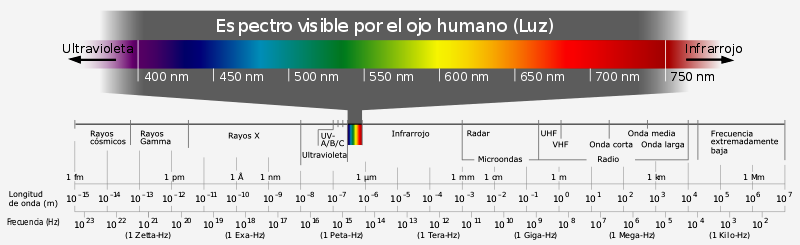
As seen in the attached graphic, the primary wavelengths are those between 200 and 2200 nanometers (nm). This section of the electromagnetic spectrum could be divided into three large blocks:
- Ultraviolet (UV) range, 10 - 400 nm
Most of the ultraviolet radiation that reaches the Earth's surface comes in UV-C, UV-B and UV-A forms, mainly in the latter, due to absorption by the Earth's atmosphere. It is evaluated at around 3% of the total radiation that reaches the Earth, it has enough energy to cause different chemical and physical reactions. For example, it causes the wear of polymers, the discoloration of certain dyes and is even capable of causing damage to human skin. The UV spectrum, ranging from near ultraviolet to the extreme, UVA/B/C rays are divided into three bands:
- UV-C, 100 - 280 nm. This wavelength is absorbed by oxygen and ozone in the atmosphere and does not reach the Earth's surface.
- UV-B, 280 - 315 nm. This wavelength is partially absorbed by ozone and only a minimum percentage of radiation reaches the surface, which is responsible for the photochemical degradation of plastics and tanning. Moderate absorption allows the synthesis of vitamin D in the skin, which is necessary for the absorption of calcium.
- UV-A, 315 - 400 nm. This wavelength is responsible for the tanning and pigmentation of human skin.
- Visible spectrum, 400 - 700 nm
It is the only range that can be detected by the human eye, this range is between 400 and 700 nanometers (nm). The energy found in this visible band is what we call “light”, because the human retina detects this wavelength. It represents 45% of the solar radiation that reaches Earth. This spectrum is where the colors observed in the rainbow emerge, ranging from violet to red. Each wavelength in the visible light band causes a certain color perception, solar radiation is more intense in the visible band light. In this perceptible range of light is where the light transmission.
- Near-infrared range, 700 - 2200 nm
It is characterized by having a long wavelength, invisible to the human eye, which covers the range between 700 and 1,000,000 nm. The radiation sources can be several, the sun, infrared heating elements or any hot object. Each type of infrared radiation is characterized by a specific wavelength. In this case, solar radiation in the infrared spectrum represents 52% of the total radiation generated by the Sun. X-rays and Gamma Rays are characterized by shorter wavelengths than ultraviolet rays.Light transmissionIt is the property of a substance to allow light to pass through, with or without absorption of incident light. If there is absorption of light by the material, then the transmitted light will be a combination of the wavelengths of the light that was transmitted and not absorbed. The transmission coefficient is a measure of how much of an electromagnetic wave (light) passes through a surface or some optical element. The transmission coefficient can be defined as the quotient of the amplitudes of the incident and transmitted waves. Thus, the measurement conditions, for the colorimetric determination by transmittance of the Y coordinate (which provides a unique value that corresponds to the physical spectral transmittance of a transparent sample as perceived by a human being) of our Polycyril, are as follows: fuzzy geometry/ 8th with inclusion/exclusion of automated specular components, Illuminant A and Observer 2nd (A/2). Comment that for the measurement of transmission to be more accurate, instrumentation effectively cancels out the effects of the lower dispersion normally found in transparent samples. As an example, a colorless sample of Polycyril will result, measured under these parameters, a global light transmission of approximately 92%. In cases where the incidence on the surface is at angles greater than 30º from the vertical, the reflection of the surface will vary and will be higher, so the overall transmission will be lower.Varieties of Polycyril by wavelengthHere is a small collection of specialties that work on a specific wavelength: Ultraviolet (UV) radiation
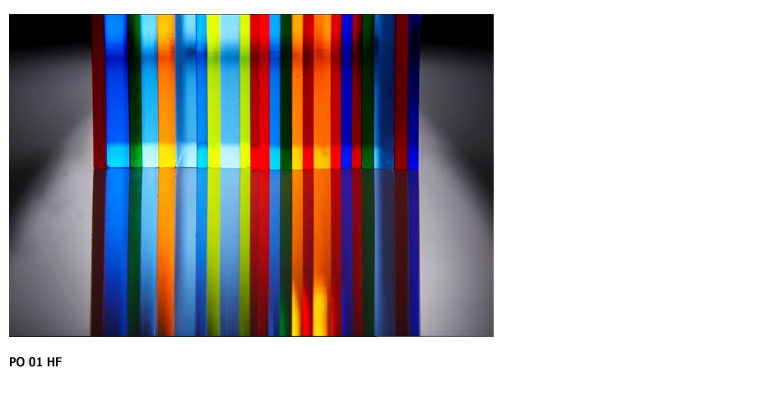
- HF High fluorescence
This Policril specialty absorbs radiation invisible to the human eye and is transformed into visible light, creating an intense coloring effect with bright and pure nuances.
- HP High UV Permeability
This quality is defined by its high permeability to UV radiation, specifically in the range between 320-380 nm, the transmission is between 85 and 91%. These plates incorporate a treatment, which allows transparency to UV radiation, and at the same time protects them from the harmful action of its effects.
- HVR High Resistance to UV radiation
These plates are equipped with filters that provide total protection against UV radiation, being completely waterproof in the range of values between 200 and 400 nm.Visible light
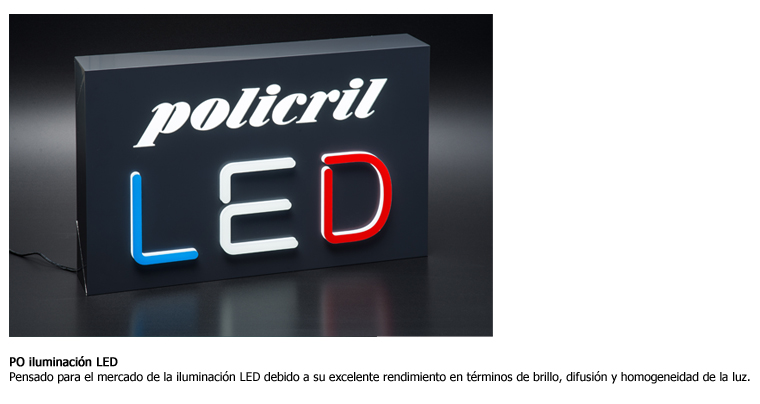
- LED Specialty for LED lighting
It is defined as providing plates with excellent transmission and diffusion properties of light in the visible spectrum.
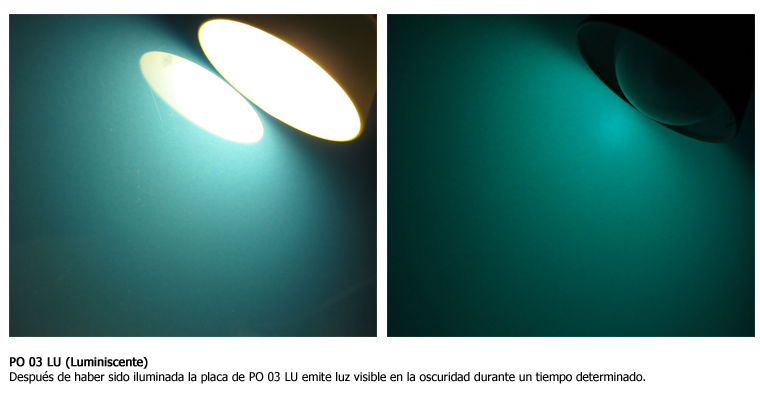
- Luminescent LU
A specialty characterized by being a plate where, after being illuminated, it emits light visible in the dark for a certain time.
- ON/OFF
Plate specially designed for backlighting, with a dark gray appearance in daylight, once backlit, it turns into translucent white at night.
- PO Blancos/Opal and transparent colors
In the case of whites, light transmission decreases with increasing thickness, in the case of colors it may not be altered by adjusting the pigment concentration of the mixture. Finally, we would like to emphasize that our plates of Polycyril can be manufactured in a wide variety of colors and qualities. Colourless PMMA plates transmit visible light uniformly across the entire visible spectrum, but these properties are altered when we use pigments to achieve our extensive offering. Remember that the quality of the finish of the surface of the iron may vary its transmission properties and its reflective capacity.