



Akyver - Multiwall Polycarbonate
Kydex - Material for industrial component parts

In the industrial components market, we usually work with materials such as metal sheets or thermoplastics, since they allow machining and are characterized by a good finish.
Sheet metal has been and is a widely used material for all types of uses and geometries, since its handling is relatively easy, allowing it to be bent, shaped or welded. But its use in jobs that require complex geometries requires a lot of work and several intermediate processes. For example, for the solution of a part with an intricate geometry, the production process will involve complex shaping and subsequent assembly of the different smaller elements, resulting in the appearance of fastenings or welds. This can easily involve the need for additional machining processes to achieve the final part having an optimal finish. In addition, on many occasions, sheet metal plates require additional painting/lacquering work to ensure durability and provide a correct appearance to the resulting part.
As an alternative to metal sheets, we find thermoplastics, such as our Kydex, which unlike sheets, are more robust, highly resistant to impact (better than compact polycarbonate) and very resistant to wear, by their nature, they do not suffer from dents or marks due to shocks on the surface. In addition, due to their intrinsic properties, they do not undergo corrosive processes over the years or due to galvanic corrosion between metals, so maintenance costs are significantly reduced.
In addition to the above, designs to the component parts of industrial products, more complex geometries are increasingly necessary and require a lot of precision, so the tolerances are very tight. The end customer wants the supplier of the component supply to make him a part that fits without problems into the final assembly of his product and that the assembly time is very short. On many occasions, thermoformed parts are manufactured on a single tool, providing high quality parts with very tight tolerances. This tolerance control provides a better fit and finish of the final part or assembly. For example, to produce a finished part with KY 02 Kydex T, this thermoplastic is formed under pressure or vacuum on a mold, allowing a part with a very complex geometry to be created at a very reasonable price.
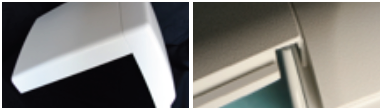
On the other hand, the fixings and fittings can be integrated into the part during forming or fixed after forming by means of an adhesive, depending on the specific requirements of the design. The integration of hardware into the finished part can eliminate secondary operations, reducing assembly time and benefiting from the lower weight and design freedom offered by thermoplastics.
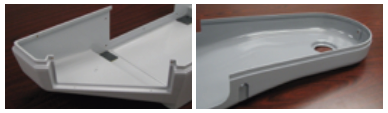
They are reliable lightweight materials, which means that, when used in vehicles, they considerably reduce energy and fuel consumption compared to when using components made of metal, our KY 06 Kydex 4545 is usually used as a material for aircraft components. Another consequence of reducing the final weight of the vehicle is that, in general, all its components extend its useful life significantly.
The constant evolution of thermoplastic materials means that, in addition to improving their design and finish, they allow us to find all kinds of specialties in the market, which are able to comply with all kinds of specific regulations. There are an increasing number of regulations to comply with, these requirements have led to a constant evolution of thermoplastic materials and there are specific specialties according to the required regulatory requirement in all types of fields such as flammability, smoke toxicity, or chemical resistance. A very common standard required in the field of electronic components is: UL94 for flammability testing of plastic materials for parts of devices and artifacts, the specialties of Kydex 100 and 150 both classify V0.
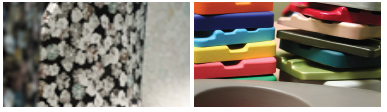
One of the biggest advantages offered by thermoplastics is that they are available in a wide range of colors. The material is made in color so it forms part of the mass, there is no need for secondary finishes or painting, and scratches are significantly concealed. Depending on the material chosen, integrated patterns and textures can even be developed to improve the look and feel of the finished piece.
Kydex is a VOC-free and recyclable thermoplastic, making it an environmentally friendly solution that promotes end-of-life recyclability and lifecycle design.
For the reasons mentioned above, it is increasingly common to use Kydex type thermoplastics, which replace component parts made with a heavier material such as sheet metal, in addition to improving the overall aesthetics of the finished design. Thermoplastic materials, such as Kydex, are impact resistant, offer excellent resistance to paint, chemicals and stains, and can be cleaned without concern for fading when mass dyed. Thermoplastics exceed many regulatory and safety standards, making them ideal for many applications, including:
- Production runs from 10 to 1,500 units.
- Short delivery times for components.
- Larger parts that generally require assembly.
- The need to improve durability and weather resistance
- Improving the aesthetic qualities of the design.

.jpg)