




Cast / Extruded Acrylic
The recycling of plastics

In this month's article, we are going to focus on the recycling of thermoplastics: how they are grouped, what types of recycling exist and how and when to choose one method or another.
Thermoplastic identification
Each plastic polymer group is identified by its Plastic Identification Code, this coding is defined by determining the composition of the plastic used, having an acronym and a code for each type.
Seven major groups are defined:
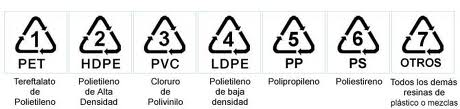
In general terms, to say that the first 6 groups are intended for mass consumption and the last, called 7 Others, is characterized by grouping technical plastics suitable for more specific uses.
1. Polyethylene Terephthalate (PET)
Polyester resulting from the polycondensation reaction between terephthalic acid and ethylene glycol. Durable plastic, suitable for contact with food and lightweight. It is not biodegradable, but it is recyclable. Used in the industrial and food sector.
2. High Density Polyethylene (HDPE)
Semi-crystalline thermoplastic polymer with a straight chain structure and very few branches. Rigid and durable, highly resistant to abrasion and impact, as well as to agents and chemicals. Recyclable, extremely lightweight material used both in the industry for the manufacture of mechanized parts or accessories, and in the food industry for the production of all types of utensils.
3. Polyvinyl Chloride (PVC)
It is the product of the polymerization of vinyl chloride monomer to polyvinyl chloride. It is characterized by being flexible, versatile, inert and resistant, as well as being harmless. Extremely versatile material that allows use in industry, construction, signage and marketing, easily recyclable, suitable for mechanical and chemical recycling.
4. Low Density Polyethylene (LDPE)
It is a thermoplastic polymer made up of repeating units of ethylene. More flexible than HDPE, highly processable, good resistance to heat and impact, as well as to chemical agents and products. It is a fully recyclable component suitable for the manufacture of objects in contact with food, protective films, etc.
5. Polypropylene (PP)
Partially thermoplastic polymer crystalline, which is obtained from the polymerization Of propylene (or propene). It is very resistant to chemical and physical agents, rigid, hard, although it lacks resilience. It is recyclable and suitable for use in both the food and automotive industries.
6. Polystyrene (PS)
Thermoplastic polymer obtained from the polymerization of styrene monomer, depending on whether it is pure or has additives, the characteristics of the resulting material differ. It is characterized by being a multipurpose material, with excellent dimensional stability, flexible, lightweight and fragile at room temperature. Recyclable, suitable for various uses, both industrial and intended for contact with food, suitable for work intended for signage and advertising.
7. Other
This group includes thermoplastics such as Methacrylate (PMMA), Polycarbonate (PC) or others.
Polymethyl methacrylate (PMMA)
Thermoplastic polymer obtained from the polymerization of methyl methacrylate. It is characterized by being a multipurpose material, easy to machine and mold, stable to the action of ultraviolet radiation and excellent transparency. It is chemically recyclable and suitable for various uses, both industrial and for protective elements or works intended for signage and advertising.
Polycarbonate (PC)
PPolymer which has functional groups linked by carbonate groups in a long molecular chain. It is characterized by extremely high impact resistance, is dimensionally stable, as well as being a good electrical insulator. Chemically recyclable multipurpose material, used in industry and construction.
The main objectives of plastic waste recovery are the following:
- Direct reuse.
- The use of raw materials.
Classification of resins and type of recycling
The first step in the entire process is to classify the type of resin using infrared, with this information the most suitable system is determined depending on the polymer to be treated.
There are three main types of recycling:
1. Mechanical recycling
Mechanical recycling consists of the treatment of waste to manufacture a new recycled pellet and then transform it again (extrusion, injection, etc.)
Types of plastics that allow this method:
- Not heavily degraded previously.
- Separated according to type of plastic by means of selective collection.
- Absence of foreign materials or particles that could damage transformation equipment or interfere with the physical characteristics of the product.
- Minimum amounts that allow for both industrial and economic viability.
Therefore, the ideal plastic waste to be recycled according to this method would be one that can easily provide clean plastic of a single type in large quantities, making it a viable option both from an economic and environmental point of view.
Mechanically treated thermoplastics PET, PEHD, PVC, LDPE, PP and PS.
2. Chemical recycling
Process by which the polymer decomposition occurs to obtain the starting components (monomers). From these, and after a new polymerization process, new polymeric materials are obtained.
Its application is feasible both in mixtures of different polymers (which avoids separation by type, reducing collection and classification costs), and in thermostable polymers.
This process is defined as changing the chemical structure of the waste and thus obtaining the starting monomer. From these, it polymerizes again and a new polymer is obtained.
Type of processes:
- Thermal depolymerization
It allows the transformation of polymers into monomers or oligomers by providing heat, without a chemical reagent intervening in chain-breaking reactions (the pyrolysis of some plastics, microwaves or treatments at very high temperatures).
- Solvolisation
A method by which the solvent also acts as a reagent. Depending on the type of solvent, we will talk about glycolysis, hydrolysis and methanolysis.
- Other chemical depolymerizations
Those that are made with a specific chemical reagent (an acid, a phenol derivative, etc.) or those that are carried out by catalytic cracking.
The catalytic cracking of plastic waste has a number of disadvantages compared to thermal cracking processes, such as the possibility of working at lower reaction temperatures (300-400 ºC) thanks to the presence of catalysts. In addition, an adequate selection of them makes it possible to control the distribution of the products obtained.
According to the class of process/type of plastic treated, polymers can be classified as:
Addition polymers (PE, PP, PVC, PS, PMMA) are primarily treated with thermal depolymerization.
Condensation polymers (PET, PA, PC, PUR) accept most chemical treatments.
3. Energy recovery
A method that converts waste into a fuel for power generation. Suitable typology for fractions of waste rich in plastic that cannot be recycled in a sustainable way.
For this reason, cogeneration plants (combined heat and energy recovery) use plastic waste together with other materials with high calorific input, thus obtaining an interesting source of heat and energy.
The resulting recovered fuel is commonly used in thermal power plants and several energy-intensive industries, such as cement kilns, and reduces the need for virgin fossil fuels.





.jpg)