





El cellular polycarbonate has a high index of light transmission making it an ideal material for the use of natural light. This, together with the high thermal resistance What it has makes it a clear choice to improve the energy savings of the locals.The plates, formed by multiple walls, create an air chamber inside the internal channels that increases the insulating power by a high percentage compared to the same compact plate material.These characteristics (good light transmitter and good insulator) often lead to the mistake to believe that the interior spaces where cellular polycarbonate is used are spaces without substantial temperature changes. They must take a series of installation precautions and choice of material to avoid increasing the temperature inside the premises.Basic ConceptsLight transmission, indicates the percentage of light that reaches the room through the plate. The transmission and light reflection factors of a glazing are the ratios of transmitted or reflected luminous flux.Light transmission coefficient (%).

The solar factor “g”, designates the thermal energy that penetrates an enclosure by means of solar radiation. The solar factor is the
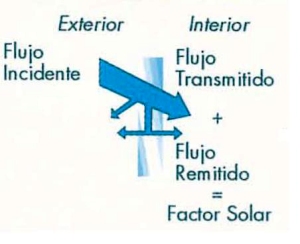
relationship between the total energy that enters a room through glazing and the incident solar energy. This total energy is the sum of the energy that enters through direct transmission and the energy given by the glazing to the interior space, after heating due to energy absorption. The lower the value of “g”, the better the protection against energetic radiation from the sun (protection against overheating), as we can see in the following table of the properties of Akyver cellular polycarbonate sheets.Total solar energy transmission factor “g” (solar factor) according to EN410.

The Value of “U”, the thermal transmission coefficient, designates the heat transfer that occurs through the central part of the plate, when there is a temperature difference on both sides of the plate. The lower the “U” value, the better the thermal insulation (the less energy is dissipated through the plate). In our case, it is related to the thickness and number of walls that form the cellular polycarbonate plate, as can be seen in the following table:Thermal transmission coefficient “U”.

Sun protection by means of glazing must be treated considering three objectives:
- Guarantee of good (high) light transmission.
- Decrease in solar inputs (minimum solar factor)
- Decrease in heat transfers from outside to inside (minimum “U” coefficient)
Solar Energy. Greenhouse effectThe wavelengths emitted by the sun that reach the cellular polycarbonate plate are called solar intensity. A part of it is reflected, another is absorbed by the plate, being emitted both inside and outside, and another part is transmitted directly inside the enclosure. This solar energy that enters is trapped in the room that tends to heat up: this is what is called Greenhouse effect. Insulating elements conserve heat without the possibility of dissipating it. To prevent heating, there are several possibilities:
- Ensure air circulation. By placing ventilation grilles, which somehow enter fresh outside air to replace hot air, or extractors that force hot air out to the outside.
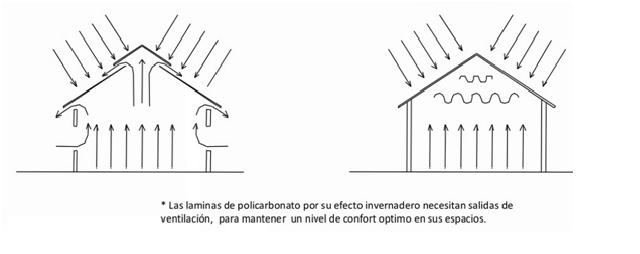
- Use sunscreens (blinds, lattices...) taking care that they do not cause thermal breaks. Placed indoors, they are less effective, since they act as a screen against solar radiation after it has passed through the panel.
- Use panels with solar control foil, which only allow part of the solar radiation to pass through and allow sunlight to pass through.
This is the case of Akyver Comfort Plus, it provides a substantial improvement, since it reduces the amount of solar energy transmitted into a glazed room, limiting the diffusion of near and far infrared, thus reducing the greenhouse effect.
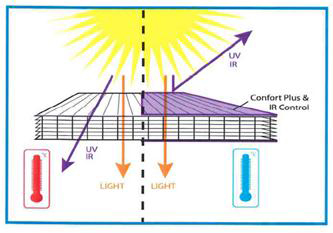
This type of plate has an anti-UV treatment and includes a reflective treatment of metal particles integrated into the outer face by coextrusion that reduces the amount of energy transmitted.