




Akyver - Multiwall Polycarbonate
Soundproofing

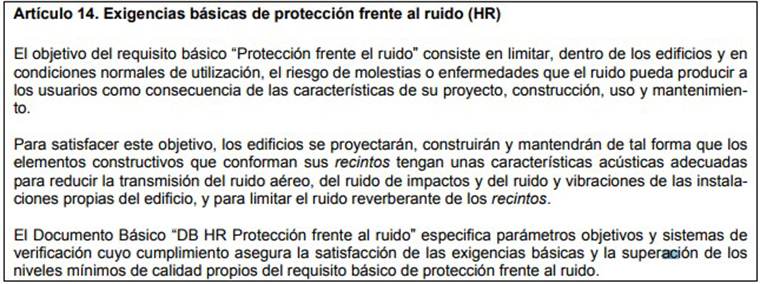
It has been common for several of our customers to demand the acoustic insulation characteristics of our products from us. Their objective is to be able to meet the demanding acoustic demands in buildings that are applied to them by the CTE and they consult us for possible solutions to respond to them with our products. With the approval of the Basic Noise Protection Document (DB‐HR) of the Technical Building Code (CTE), much more demanding values were established for acoustic insulation in buildings. In order to meet the requirements required by the aforementioned standard, already in the design phase, construction solutions had to be envisaged that allow us to comply with it and then, during the construction phase, carry out an exhaustive follow-up to verify their correct execution. To give us an idea, below, we will make a brief summary of the demands to which both buildings and construction materials are subject, depending on the use and where they are going to be installed.What does the CTE DB-HR requireIn the Article 14. Basic Noise Protection (HR) Requirements of the CTE, establish both the objectives and the basic requirements of the standard, for the buildings in which it is applied.
How to respond to these demandsIn order to achieve the acoustic objectives required by the DB‐HR, solutions must be designed and dimensioned to respond to acoustic insulation to airborne noise and impact noise, reverberation time and acoustic absorption in specific areas of the building and to the noise and vibrations caused by the building's installations. Thus, in order to comply with the requirements, the chosen constructive solutions will be determined by: - Acoustic insulation of each construction element. Although the regulations together establish acoustic requirements for the finished building, it is necessary to know the acoustic behavior of each of the solutions used by the designer. Therefore, the partitions, the horizontal and vertical separation elements, the facades, the roofs or the floors in contact with the outside will be dimensioned to meet the established values according to the use and location within the building. - Design conditions for joints between construction elements. The meeting points between different planes characterize the lateral transmissions and are decisive in the final acoustic insulation, so, during the execution of the work, it is important to control both the insulation of each construction element and the joints between them. For this reason, it is important during the dimensioning and design phase to have supporting documents that explain the acoustic insulation assigned to the construction element. Thanks to laboratory tests, manufacturers can provide designers with the requested values through tests regulated according to the regulations that apply to them. In this case, depending on the acoustic requirements, whether in the laboratory or in situ, the tests would be carried out in accordance with the UNE‐EN ISO 10140‐ (1 to 5) family of standards for insulation and UNE‐EN ISO 354 for sound absorption.
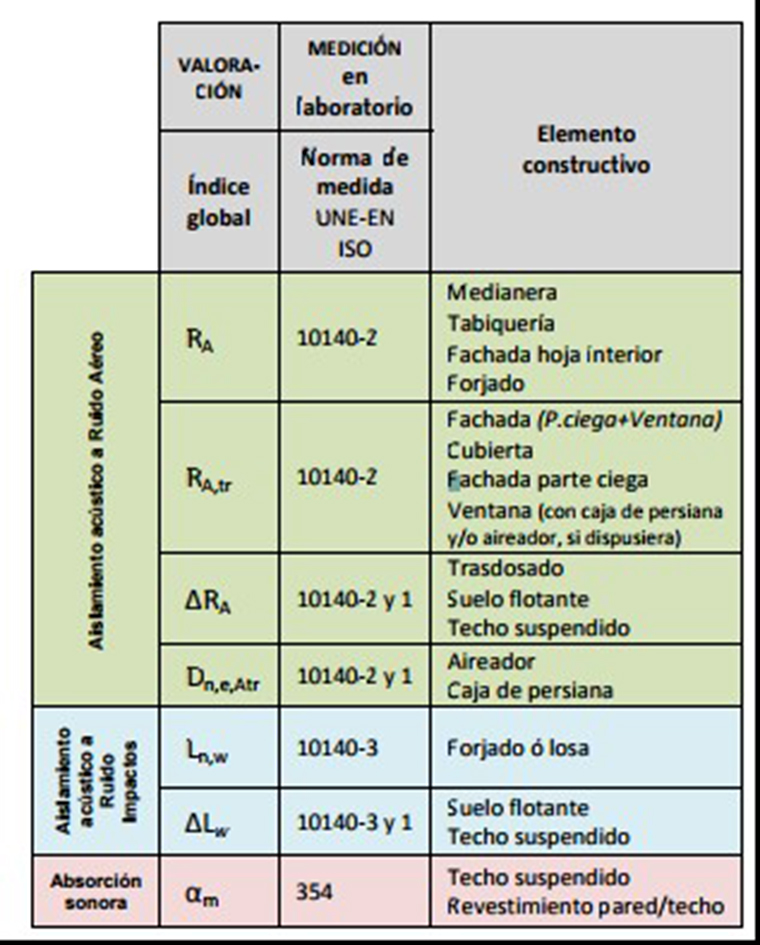
As an example of standardized testing of envelope material, we will take a product from our catalog of cellular polycarbonate systems, the AK10 60/500. In this case, the test to which the product has been subjected is based on the UNE-EN ISO 10140-1:2016 *, UNE-EN ISO 10140-2:2011 ** and the UNE-EN ISO 717-1:2013 ***
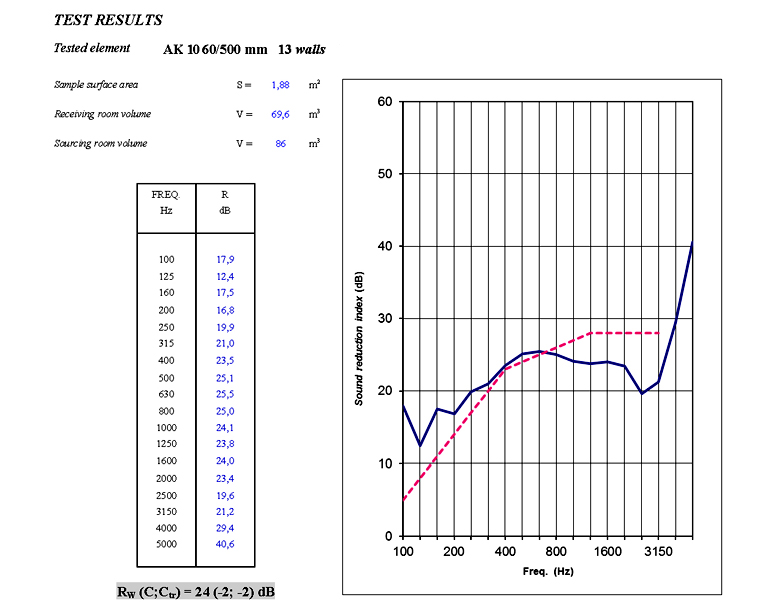
In this case, the result of the test determines that the R'**** value (apparent sound reduction index) is 24 dB. In general, once the appropriate construction solution has been determined during the design phase, the appropriate construction of the element will be verified during the construction check and, in addition, the execution will be controlled according to the acoustic design of the encounters of the element with the neighboring elements, pipes and installations. A minimum verification frequency is recommended for each type of construction element and plant. of the building under construction.* UNE-EN ISO 10140-1:2016 Acoustics. Laboratory measurement of the acoustic insulation of construction elements. Part 1: Application rules for specific products. (ISO 10140-1:2016) .** UNE-EN ISO 10140-2:2011 Acoustics. Laboratory measurement of the acoustic insulation of construction elements. Part 2: Measurement of acoustic insulation to airborne noise. (ISO 10140-2:2010) *** UNE-EN ISO 717-1:2013 Acoustics. Evaluation of acoustic insulation in buildings and construction elements. Part 1: Airborne noise isolation. (ISO 717-1:2013) .R' ****, the apparent sound reduction index in dB, which includes the sound power incident on the separating element of both rooms and the total sound power transmitted to the receiving room, including sound power transmitted through side elements or other components. The R' index is calculated according to the following formula:

Being:D: difference in sound levels between emitter and receiver rooms; in dBS: area of the separator element; in M2a: equivalent sound absorption area in the receiving enclosure; in M2t: reverberation time of the receiving enclosure; in sV: volume of the receiving enclosure; in m3 With the frequency-dependent airborne noise insulation values (index R'), unique numbers were calculated, which characterize the acoustic behavior of the partition taking into account typical noise spectra.







.jpg)